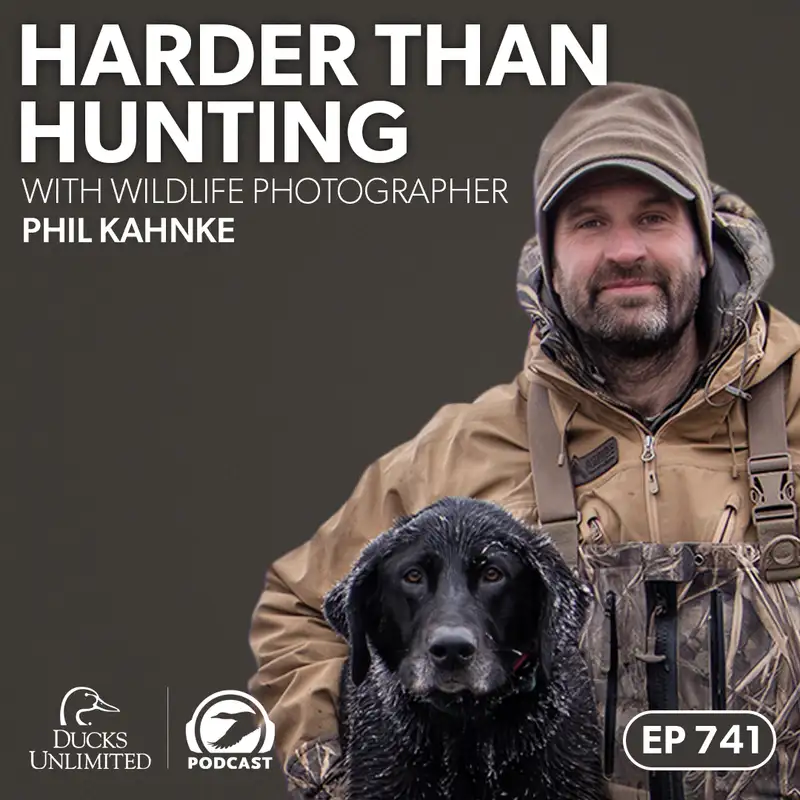
How a Top Waterfowl Photographer Plans, Hides, and Captures the Shot (Ep 741)
Can we do a mic check, please? Everybody, welcome back
VO:to the Ducks Unlimited podcast. I'm your host, doctor Mike Brazier. I'm your host, Katie Burke. I'm your host, doctor Jared Hemphith. And I'm your host, Matt Harrison.
VO:Welcome to the Ducks Unlimited podcast, the only podcast about all things waterfowl. From hunting insights to science based discussions about ducks, geese, and issues affecting waterfowl and wetlands conservation in North America. The DU podcast, sponsored by Purina Pro Plan, the official performance dog food of Ducks Unlimited. Purina Pro Plan, always advancing. Also proudly sponsored by Bird Dog Whiskey and Cocktails.
VO:Whether you're winding down with your best friend or celebrating with your favorite crew, Bird Dog brings award winning flavor to every moment. Enjoy responsibly.
Matt Harrison:Hey, everybody, and welcome back to the Ducks Limited podcast. I'm your host, Matt Harrison. And today, we have a very special guest joining us remote, but it is an individual that I am extremely excited about hosting on the Ducks Limited podcast because he is someone that I have followed for a while. He is someone that is incredible at what he does, and I'm so excited to be able to ask him some questions and us be able to share those questions with you. We have very special guest, Phil Conkey joining us.
Matt Harrison:Phil, how are you doing this morning?
Phil Kahnke:I'm doing well. I appreciate the introduction, and good morning, everyone.
Matt Harrison:We are super excited to have you on the DU podcast. I'm just excited because I get to ask you a bunch of questions because I love photography. I know that you love photography, and I know a lot of people know who Phil is because you are truly one of the top tier waterfowl photographers and one of the most renowned and one of the most followed. So I know that, you know, waterfowl photography has become something that has really become popular, you know, over the last five or so years. You know, I feel like a lot of people Tota Camera Now.
Matt Harrison:There's a lot of people out there that take not just waterfowl photos, but, you know, they take hunting photos or they take any type of outdoor photos, and it's something that even I have seen over the past couple years just really grow in the outdoor industry. And, Phil, you have been around a long time and have taken some incredible, I'm talking about phenomenal waterfowl photos. I know that if you are on social media, at some point, you have crossed a Phil Conkey photo because a lot of people share them, and they're just they're truly remarkable, remarkable photos. So I do want you to tell our listeners a little bit about your story, kinda how you got involved with waterfowl photography, if it's been a passion of yours for a long time, or is it something you stumbled upon. But we wanna just give the floor to you to tell our listeners a little bit about your story.
Phil Kahnke:Thank you. Appreciate that. I guess my photography story is really tied directly to my duck hunting story, which, you know, like most duck hunters begins with my dad getting me into duck hunting. I watched him since I was, you know, little, four, five, six years old, do all the preparation for hunts, and get excited about hunts, and talk about it, and all that kind of stuff. And every bit of that was interesting and exciting to me.
Phil Kahnke:And so as soon as I had the chance to duck hunt, I started doing that, and I mean, I was hooked from the time I was seven or eight years old. The first time I went out and, you know, stood in the slew in the dark and had a flock of wood ducks come in. So that hooked me in the duck hunting part. My dad oh, jeez. I must have probably been 12 or 13 years old, and I'm 49 now, so that was a while ago.
Phil Kahnke:He bought me a camera, which actually they're they're popular again now, a Canon AE one because film photography has become a thing again. That was one of the first cameras that had auto exposure, so it was a little bit easier to get started with film photography. And he bought me one of those, and I used it for things around the yard and flowers, and I water skied back then, and we took photos of that, and friends playing basketball, and all sorts of stuff. And then I wanted to get into taking photos of ducks because I love ducks, and we had a lake that was almost a cattail slew right in town where I lived, a few blocks away from me. A friend of ours is a professional photographer in town.
Phil Kahnke:He let me borrow probably like a 70 to not a 70 to probably like a 55 to 300, you know, kind of a cheaper lens with a little bit of telephoto, and it it got me enough that I could see that I was not there yet. You know, I'd take a picture. You know, this is you know, so I had to get a picture developed, and I'd have a picture of a Mallard, and it was a little speck in the middle of a four by six print. So it was frustrating. I didn't we didn't really have the money to go out and spend on on big lenses back then.
Phil Kahnke:So I kind of let that part slip away for a while. I had at least established a very solid photography understanding, I guess, as much as you could for a 12 year old that didn't have Internet and that type of stuff. And then high school came, and I didn't really do a lot with photography for photography for a while. And then right as I was graduating college is kind of when digital was just coming into something where there was consumer cameras available, and they were not very good, but I bought one. And I bought a 70 to 300 lens, and I'd go down to this is when lived in Minnesota, and I'd go down over Minnesota, take pictures of geese.
Phil Kahnke:I was trying to learn learn how to do that, and could see still that, you know, it was frustrating. You didn't have a lot of success back then. The cameras were not great. Lens was not long enough. But I could see that I'd occasionally get a cool photo that I thought was something that was, like, okay.
Phil Kahnke:This is neat. And so, I mean, it's been a it was a process of on and off, and I I started, quit, started again. Then after that first experience with digital, I wasn't really loving it because it was I just wasn't getting the things that I thought I was was reflecting what I was seeing. And so I I put the camera away for a few years, and then I picked it back up again a few years later, probably in the mid, like that $2,006.07 range, and I bought a little bit better gear. And then I was seeing that the potential was there, and that's when I kind of really jumped in and said this is something I'm gonna I'm gonna try harder at and at least give it a real shot.
Phil Kahnke:So it's been on and on and off since probably 1990 that I've been been doing photography.
Matt Harrison:That's incredible. To see where you started to be now, where you're at is is so cool to hear how that originated and how you ended up in the position you are today. But do you have a photo that sticks out to you that was one of the first ones that you took that you just said, wow. Like, this is incredible. This is what I could do to make a living.
Matt Harrison:Was there that one kinda instance or scenario that you remember starting out that really popped out to you?
Phil Kahnke:So, yes, there was an absolute specific moment that I knew everything kind of clicked. This was this was back in about 2007, which to me doesn't necessarily feel like a long time ago, especially I don't feel like I've been doing this that long since there's a lot of people who did this stuff before me. Those are the ones I looked up to, but for a lot of folks, 2007 would be a while ago. And I I had made the I sat I was sitting at a slew here in South Dakota. I had just moved here that previous fall.
Phil Kahnke:I saw all the ducks around, and as I I picked up some better equipment, and I told myself, I have to get out of the truck. There's no way I'm getting these pictures that I want from sitting on the side of the road. So I got my Carstons, I paddled out to a spot. I was laying in the bottom of my Carstons with very little cover, few decoys out, and I had a redhead come low to the water, and that's always the key for these photos is you need these things to be low. And they came, and I snapped off a bunch of photos, and I remember I turned and I looked at that back of the camera, and I thought, oh my god, this is like the stuff David Stimick takes.
Phil Kahnke:These are the things that are on the covers of magazines. And I thought, okay, like, I can do it, now I just need to refine it. And it's been a long process, and I was not good back then. That photo was really good. I didn't I didn't really have everything nailed down, I don't think even I mean, I'm still refining that process now, but I remember the moment that that that picture popped up, and I was like, wow.
Phil Kahnke:Okay. Like, I'm I have the ability to do the thing. Now I need to put the time and effort in to learn how to to really do it.
Matt Harrison:That's really cool. You know, people tend to see the final image a lot of times. Right? You know, whether you're scrolling on social media or you see it in the magazine, you know, you see that final image that's edited, that's perfectly cropped, that's just a beautiful, beautiful image of a duck or a goose. You know?
Matt Harrison:But what people don't see is what it took to get that image. So what are some things that people don't see that go behind the scenes, you know, the the effort that it takes, you know, getting up on the cold mornings or the long drives? What are some things that Phil Conkey does behind the scenes to get some of these photos that we're talking about that people do not get to see?
Phil Kahnke:So there's a lot, and it's I I approach it like I would a duck hunt. I wanna be successful when I go out every time, and to do that, I'm putting in pretty large amount of scouting, whether it's every day or whether it's before, like, my photography season kicks off to to find the spots that are gonna work, that are accessible, that have the right water levels, that have the right backgrounds for an evening shoot when the wind the sun is at, you know, at the west, or a morning shoot when the sun is at the east, you know, so you don't have a a building on one side of you or a highway or a telephone pole or whatever there is that would interfere with your pictures. You need to know where if you can hide and how the ducks are gonna approach and if there's ducks there. So there's all of those things that go into a duck hunt plus all the aspects that you need to have for photography. So to get a duck in, to be a have a successful duck hunt, you need to get them to 30 yards.
Phil Kahnke:If they're above you, no big deal. You just shoot them. But to get a duck in, you know, it needs to be down low. You need to have all the the sun, the wind, the time of day. All these things have to align that add to the difficulty of that.
Phil Kahnke:So all those things, like, factor in. So, I mean, when it's when it's that time of year and then I'm really focused in on that type of photography, I mean, all day long, I'm checking the weather for the next morning or the next evening to see which way the wind is gonna be, what way the sun is gonna you know, obviously, I know which way the sun is gonna be, but if it works for my morning shoot or an evening shoot or however I can do it and sneak that in, and is it is it gonna be cloudy? And then you have to try to figure all that into the equation with are there ducks on these spots that you're wanting to go to? Because there's a lot of times, and when I started, I used to just go shoot photos of ducks wherever they were, and there could be 2,000 ducks in a plowed cornfield that was turned pure black, and I'd go sit there and take a thousand photos, and I'm like, man, these are awesome, but then and it never really connected to me, like, why the photos didn't get used as much for things, or, you know, maybe why what why I didn't connect why they looked different than these other people that I liked, and then all of a sudden I started to focus on the big picture of not just the ducks themselves, but incorporating the outside aspects of backgrounds and really keying in on weather circumstances for the day.
Phil Kahnke:And then that's when I feel like my the level of my photography really jumped from okay to good. And that was not that long ago. That was maybe only, like, 2018, 2019 Wow. 2020 where, you know, I had tons and tons of neat and cool photos before that. They just didn't quite have what I would maybe consider now, like, the finishing touches to make them
Matt Harrison:Mhmm.
Phil Kahnke:To make them That much better. That much better. Yeah.
Matt Harrison:And what people don't truly understand is, you know, it it sounds simple. Right? It sounds simple to say, you know, the sun's gotta be right. The wind's gotta be right. But to have, you know, the perfect wind, to have the perfect lighting, to have the perfect hide, you know, to not be in a position that flares ducks, you know, it's Mhmm.
Matt Harrison:There's a lot that goes into it to get just one of the shots that you're talking about. Yeah. You know? You know, if if a duck's coming in sideways versus straight at you, you know, and that that may be what you're going out there looking for is a specific shot. But Yep.
Matt Harrison:If the wind's off just a little bit, you know, I mean, they're gonna be finishing a different way, or if the sun's not hitting them just right, you know, you have all these different variables that could make it just completely shift in the wrong direction for a photographer. And, you know, when you look at one of these finished photos, you really don't take a second to think about, man, look how incredible this photo is. He had to be in the perfect spot, had to have the perfect wind, had to have the perfect lighting, had to have the perfect hide. You know? But when you do take a step back and look at all those variables, you're like, man, you appreciate it a little bit more than you would by just scrolling past a good photo and saying, man, that's a good a good shot.
Phil Kahnke:I mean, it's almost amazing that it ever works out, to be honest, because of Exactly. All the things that have to come together. I mean, it's 10 times harder than duck hunting. To get a No. I'm here, please.
Phil Kahnke:Successful photo shoot is 10 times harder to have happened than having a successful duck hunt. I mean, there's days where I go out where I I maybe don't get a ton of great photos, but I could've shot endless ducks. Exactly. But but the photos are meh, lackluster. So it's very it it's a it's a very different thing, and it's it's also, you know, using your duck hunting skills and experience helps all of that.
Phil Kahnke:And at the same time For sure. The photography part sharpens your duck hunting skills in the reverse. Yeah.
Matt Harrison:Exactly. How how much waiting goes into, let's say, one of your just wow photos? You know, like, one that you're like, this could be on the front of a magazine. You know? And I and I get it.
Matt Harrison:Again, everything's gotta line up. Right? So it may be that the first day it all comes together and boom, you get one of those photos. But just over a you know, let's say a time span of a year, you know, how often do you get one of those shots that you're just like, man, this is this is incredible?
Phil Kahnke:A lot of it depends on the year, what I have available for DUCs, because the migrations are different. A lot of it depends on what we have around for water, and which in turns, you know, can affect the duck migration in our specific area. So I feel like each year, I maybe have 50 to 100 photos that I separate that I feel like are real likely contenders for, like, a cover shot. And that's out of a couple 100,000 that I probably take, maybe probably more than that. You know?
Phil Kahnke:But but that's so Oh, wow. That number is is you have to think now also that these cameras can take 20 to 30 photos a second. Yeah. You know, when I started, if I came home and after I edited, if I had a 100 photos that I kept from a day, that was a lot. I mean, now I'm to the point where it's hard to cull down a day to 500 sometimes.
Phil Kahnke:And that's with getting rid of a lot of images that are very similar to each other because the not only can you shoot more photos per second, but the cameras have improved to a point where your success rate is a lot higher. So the waiting part, patience is definitely a thing, but I feel like when I'm out there, I've usually put myself into a spot that's gonna be pretty good most of the time. There's days where I know that I'm I'm literally waiting for one thing to happen because I might not see a lot of ducks. And if that one thing happens, it's gonna be great. And I've had a few of those days work out where it does happen.
Phil Kahnke:Those first couple hours of the morning and the last couple hours of the morning, that's, you know, when the good light is there. And most of the time, you're you're usually fairly active with some type of activity of ducks. So you're at least watching if you're not shooting some photos. But, yeah, like, there's definitely days where you you have a specific thing in mind that to get that one shot, you're waiting and waiting and you're waiting and you're waiting through a lot of other activity that maybe isn't of great consequence or the photos are not amazing, and you're just waiting, hoping for that one thing. Because, of course, you're at you're at the mercy of what the duck to do.
Phil Kahnke:You can have everything right and still Mhmm. A duck might turn right when you want him to turn left, and the photo is completely different because of that. Patience is a thing and just waiting it out a lot of times can pay off, sometimes it doesn't. But, yeah, if it's not one for the, for some of us too anxious, that's for sure.
VO:Stay tuned to the Ducks Unlimited podcast, sponsored by Purina Pro Plan and Bird Dog Whiskey. After these messages.
Matt Harrison:So you spend a lot of time outdoors field chasing ducks, whether it be hunting or taking photos. And so I'm sure that you have had some situations that have turned a little sketchy. So can you share any stories with us that almost turned into a disaster?
Phil Kahnke:Yes. I probably have a couple. One for sure that and and it turned out well, but it was very close to being a real pain in the butt. This is probably ten years ago. I had a a day off from work, and I had found a spot.
Phil Kahnke:It was during a it was during the middle of our spring when we had a real big freeze up, and there I found a real big slough, real big cattail slough that was flooded, and there was thousands of ducks on it that had congregated as everything froze back up, and they they had a a pretty decent sized open water. I could see it, and it was probably, I would guess, a third of a mile off of a road, maybe a little bit more than that, and I had permission to go in on it. And the only way to really get there was to go I was planning on going through the water. Well, I got there, it was frozen, of course. So I had I had my sled with all my stuff in it, and I I started walking out of the ice just to see if it was strong enough or if I'd break through, assuming I would break through and I have to break ice to this thing.
Phil Kahnke:Well, I had to I walked on the ice the entire way to this open water, which was like a third of a mile. And I get out to where the open water was, and the ducks were on the far side of it, so I hadn't really messed with them at all yet. And I was anxious because it was really good. It was it was the perfect scene, absolute ton of ducks, pintails and mallards mainly, like everything you would want. And I got to where the open water was, and usually by then you would have fallen in.
Phil Kahnke:Well, I didn't. And I did not know how deep this water was. So I'm standing here on the ice, and it's cold. I mean, it was in the probably low twenties, maybe colder than that. I'm like, well, what do I do here?
Phil Kahnke:So I it was not the smartest thing I've ever done, but I just hopped into the water, and it was about belly button deep. And, of course, every second of that, every microsecond of that fall until my feet hit the ground was, oh, for the love of God, let it stop quick, and it didn't, and it didn't, and then finally, I didn't get wet, didn't go over my waders. And so I'm standing in this deep water where I can't really put my arms down. I have to kinda hold them up and hold my camera up, so I got all my stuff together, got my camera out of my sled, shoved my sled back on the ice into the cattails as much as I could, and I sat in that spot for, I don't know, two hours basically until my camera I don't know if my if my camera battery died or if my memory card was full, but one of them and luckily then, because I was shaking so bad, was so cold that I couldn't hardly, like, take it anymore. And I I was able to clamor my way back up onto the ice, and I started walking, and it and this had been this was I didn't get out there till how little later in the morning I would have wanted to, and it got warmer that day, so the ice became weak.
Phil Kahnke:And for the majority of that walk, I had to bust ice with, like, my elbows and my knees and my sled to get back to my truck. And it was most of it was deep. Luckily, the last, like, few 100 yards were, you know, I could just bust it with my feet and just walk, but the vast majority of it was like each piece of ice was a chore to break, which the only good thing with that was it heated me back up real quick. I wasn't very cold for very long. But, I mean, it took me, I don't know, an hour or more to go a third of a mile probably.
Phil Kahnke:Wow. So I got lucky, but the pictures paid off, and, I mean, I still post some of those photos today. Wow. And it was it was a super cool day, but, I mean, I almost I was maybe a little over rambunctious to get in there and do that. I don't know that I would do it today.
Phil Kahnke:I probably still would, you know, have a little bit of Mallard fever yet. But, yeah, that one could have been real bad.
Matt Harrison:Yeah. That would have been really bad if you would have found out that was about six foot deep.
Phil Kahnke:Yeah. Would yeah. I'd been floating, and, yeah, I'd have been in a world of hurt then.
Matt Harrison:There's no doubt. Now do you prefer taking photos on a beautiful sunny day or snow?
Phil Kahnke:So each has their own their own pluses. Obviously, snow kinda has that extra feeling of, you know, the the day the duck hunter dreams of, that type of stuff.
Matt Harrison:Mhmm.
Phil Kahnke:And you can really catch some real cool photos on that, but the the photos that you that you're, like, you're looking for that beautiful lighting and the detail and kind of the the dramatic lighting. That's always gonna happen on a sunny day. Yeah. It usually happens I I prefer, like, I don't know, a half hour after sunrise till maybe an hour, a half after sunrise, somewhere in that time. Mhmm.
Phil Kahnke:Right at right at sunrise, it's so golden that sometimes the colors almost look funny. Wow. And too almost like almost like too saturated and too gold. Yeah. Which I would rather have that problem than being a really gross, just gray day.
Matt Harrison:Yeah.
Phil Kahnke:Dark gray. Like, some clouds are okay. Like, cloudy isn't always bad, and you can really get some neat shots on clouds. And I know some people will not won't go on cloudy days. I still will because you do get some neat stuff, and it's a different look.
Phil Kahnke:But if I could only have one, I'd probably take the sunny days, but I do have some really cool days that I spent out in absolute blizzards taking photos with huge smile on my face because it was just, like, the thing that Incredible. Yeah. Just a very it's just a very cool scene to be around.
Matt Harrison:And it makes it really feel like duck season. You know? When I go out duck hunting and it's freezing cold and you got a little sleet or a little bit of snow, you're just like, this is duck season. Yeah.
Phil Kahnke:Yeah. It's the it's the things you hear about and read about and you tell stories about. Like, you know, it's it's not the story isn't as cool when, oh, yeah, it was this beautiful sunny day, even though you the hunting might be better then, but it isn't as dramatic and doesn't seem as cool. So, Those those photos have a special feel to them, and it's a quality.
Matt Harrison:For sure.
Phil Kahnke:Like, when I post a snow photo, everybody likes that.
Matt Harrison:Loves it. Yeah. Yep. What have ducks taught you from behind the lens that most hunters probably don't notice?
Phil Kahnke:A few things I would say. I mean, one is how absolutely critical hiding is to hunting success. And and I've and I've focused on hunting. I mean, all of my friends probably that hunt with me probably say I'm the most anal person when it comes to hiding our boat or hiding ourselves wherever wherever we're hunting. I am very particular about that because it matters.
Phil Kahnke:I mean, I would rather shoot. Yep. I don't I don't wanna shoot a mallard at 40 yards. I wanna shoot him at 15 yards, and I don't want him to even know that he's being shot. Mhmm.
Phil Kahnke:I want it I want it when we pull up the chute, it just happens, and they don't even know. So hiding is huge because you have to get these birds down low below the horizon, and if someone thinks they do that a lot when they hunt, I would I would challenge them to say, okay, we're not gonna shoot until that bird crosses the horizon, and it doesn't happen near as much as you think. So to get it to happen, the hiding is so critical. That's one. You know, another thing that I've really learned too is, and this has helped a lot in hunting, but it's helped you analyze how ducks will work a certain hole, whether it's a cattail slew or a big lake or, like, a willow hole or something like that.
Phil Kahnke:They they don't always work it the way that you just initially think that they will, And just the the way that these things lay out and the way the wind is, it can change dramatically how they work a hole. And I feel like I've really come to analyze that and how I position myself in that spot to try to hide better and, you know, use use the geography itself to hide and not make yourself the center of attention and allow for a photo to work or a hunting situation to work.
Matt Harrison:You know, and I think that's one of the most overlooked things, even when you you just talk about, you know, normal duck hunting, that people don't really realize how critical it truly is, is hiding.
Phil Kahnke:Mhmm. Absolutely. They don't. I mean, when you see pictures of blinds all the time or driving around in some of the spots we hunt, I mean, you can see people from a mile away. You can see their boat blind from a full mile away.
Matt Harrison:If you can see them, guess what? Yeah. Another 100 yards up can see you.
Phil Kahnke:Yeah. 10 times better, especially with better with better eyesight. So it's a huge difference. I mean, and it's I mean, if there's one thing that is important for duck hunting to me, I mean, it's the hide. It need to be where some ducks are, but the hide is the absolute most critical piece for me on that.
Matt Harrison:If I'm not mistaken, did you not share a photo a little while back of one of your hides? I think you did, and it was Yes. Absolutely incredible. Like
Phil Kahnke:Yeah. My dog. It's
Matt Harrison:it's phenomenal.
Phil Kahnke:Yep. Yeah. Like, it blends I mean, the only thing you can see is the little opening where the dog comes out. Yeah. And and I and I definitely take a little pride in that, both in designing the blind, the boat, the blind itself, because I I like to make boat blinds, but then in also, like, that last little bit of that finishing touch of, hey, we need one more clump of grass to do this part of the boat right here, then we're done.
Phil Kahnke:And as soon as someone someone who hasn't hunted with me probably thinks it's annoying until until that first flock is in, and I don't call the shot when they circle at thirty, and I said, just wait, they'll come back, and then they do, and they come back, and they land at fifteen. And rather than shooting two, we shot four or five over that bunch. Yeah. I'm I'm big on hiding, and and photography has absolutely drilled that home because you have to have them that close to get those photos.
Matt Harrison:So Yeah. No doubt. Is there one species of ducks that constantly just refuses to cooperate? You know, is there a species that just seem to kinda be a little bit more leery that you have noticed? You know?
Matt Harrison:In hunting, I feel like a pintail a lot of times can kinda peek you out a little bit quicker than, you know, maybe a mallard or a gadwall. And, again, that's just my opinion. I don't have anything to back that. But is there one species as a waterfowl photographer that just kinda seems to pick you out a little bit quicker than the rest of them?
Phil Kahnke:Pintails absolutely have provided me the most son of a moment, like, where you're just, you're ready to hit the shutter, and right as you're about to hit it, all of sudden, boom, and they're gone.
Matt Harrison:Yep.
Phil Kahnke:They you see them you see them turn their head a little bit, and then and they're like, oh, crap. Here it comes, and they're gone. So, yeah, that's a pintail's for sure the one that picks you out the most, which actually kinda goes back a little bit to the thing that what ducks have taught me, is how much they look around. Because you can when you're taking photos, you catch you don't necessarily always see it as you're watching them, but a photo, you'll see them turn their head a little bit, and they put that focus of that one eye right on you, and right then, and then that's almost always followed if you're not hidden by the next picture being wings open and spread and getting the heck out of there. Yep.
Matt Harrison:Which is
Phil Kahnke:So and a pintail is is the worst for it.
Matt Harrison:With that being said, what's your favorite duck to photograph?
Phil Kahnke:You know, like, for hunting, it's it's surely a mallard. That's the thing I like to do, like most people. But, god, I I'm almost I don't know. It's super hard for me to say because, honestly, like, when a ringneck comes in and I'm taking a photo of a ringneck, I have a feeling that the smile on my face is as big as when a mallard or a pintail or a canvas back does it because just the actual act of getting them in close and knowing that that picture is is being recorded Yep. Is so cool.
Phil Kahnke:But, man, I think, like, the ones that make me the most nervous that I'm maybe the most excited about are cans.
Matt Harrison:Really?
Phil Kahnke:Just simply due to we don't we don't get a ton of them. You know, they're a super respected duck. They're hard to get a real cool photo of with their coloration. It's hard to get a real dramatic photo. And they're not and they're and you can't manipulate them like you can a mallard, don't think, as much.
Phil Kahnke:Exactly. A mallard, you can call that. In spring, you can't really call it mallards as much as you can in the fall. But even with decoys, all, like, you can manipulate a mallard more so than you can a canvas bag. So cans are probably the one that really, like, get me the most excited.
Matt Harrison:Yeah. For sure. I tell you what a species of ducks that I have come across on your page that really stick out are some redheads. You have some incredible photos of redheads on your page.
Phil Kahnke:So they're the opposite of a canvasback or a pintail. They are the, for sure, the most camera friendly duck you could could come across, which is great because sometimes that helps on a slow day. You know? And I think it was I don't know if it's the most recent Ducks Unlimited magazine, but maybe from the previous one that I had that cover, and it was a redhead. And it was a photo that I it was super cool because it was one that I had specifically tried to get.
Phil Kahnke:It wasn't I didn't know it was gonna be a redhead, but the scene, the lighting, the setting, the back the background, and that duck came in and did exactly the thing I wanted to. And it was a redhead, which would probably be the most fitting because they tend to do the things that you want the most often. But, yeah, when you can hit them with the right light and get them to where they really especially when they really show their back with all that vermiculation on their back. Mhmm. They're just a really pretty bird that
Matt Harrison:They are.
Phil Kahnke:Some they they're underrated, I would say.
Matt Harrison:They're a beautiful bird.
Phil Kahnke:People you know, a lot people maybe don't see them too often. They
Matt Harrison:are. Yep.
Phil Kahnke:That I love and I always love the contrast on the divers. I love that white, that black chest to the white belly. I love that contrast line right there. I've always liked that too.
Matt Harrison:No doubt. No doubt. Well, what's something you wish that more wildlife photographers understood about ethics? You know, it's something that's not really talked about a whole lot when it comes to waterfowl photographers, but you've been around the game a long time. You know a lot of other photographers.
Matt Harrison:You know, what is one thing that you would kind of tell some other photographers maybe that are just getting started or have been in it for a little while, what would you tell them to kinda watch out for and make sure that they understand about ethics?
Phil Kahnke:That's a can of worms. There's whole Facebook pages devoted to this kind of stuff. Man, and, you know, like so everybody has their own ethics, and, of course, I I mean, I'm pretty opinionated when it comes to photography and duck hunting, and I definitely have some strong feelings about things. I guess my own ethics that if I'm going to consider myself a wildlife photographer, which I don't consider myself a waterfowl and a hunting photographer. I don't take deer photos, but it's wildlife, so I get lumped into that group.
Phil Kahnke:And so for me, wildlife is truly wild birds or wild animals in wild places. I've kind of what maybe the thing I have drawn up from my own own set of rules is if I can stand up and those birds know I'm there and their behavior doesn't change drastically, I don't feel like I'm participating in the activity of wildlife photography. I'm taking photos of animals, but to me, that is not wildlife photography. And I don't know how that translates to other people. I I guess maybe what I don't like is when that other side of it portrayed as wildlife photography because it's a very different thing in terms of the work and the effort and the experience that goes into it, and I feel like it maybe cheapens a bit the actual thing of what I consider to be wildlife photography.
Phil Kahnke:For me, the the experience I mean, the the end result of what I do is some cool photos on my computer, or on a magazine, or on my garage wall, but that's not necessarily the whole reason I go, and in fact, it's it's probably not even half the reason I go. The majority of the reason I'm out there is to be out there doing the thing with those animals, seeing all this cool stuff. I love ducks. I love watching ducks come to come in. And so for me, like, if you're if you're taking a photo of a duck at a park and then portray it as a duck in a wild place, I think you're cheapening that other part of it.
Phil Kahnke:Absolutely. So that's my soapbox about wildlife ethics. And then I know there's people that are on both sides of it, and that's fine. They can take the photos. And there's some really cool photos.
Phil Kahnke:Like, I I still think they're neat photos, and and a lot of times, like, you know, they get the super detailed shots like that. And I think people would like it. I would I would love it more if I would still love the photo, and I would love the portrayal of it even more if they just said, yeah. This is where I took it, and this is how I took it. Don't try to say it's something else.
Matt Harrison:Exactly. So No. That's a very good point. And, you know, I think a lot of other photographers would agree with you on that as well. You know, is y'all spend a lot of time outdoors.
Matt Harrison:You put a lot of time and effort as we've talked about, and all that goes into creating, you know, a one in a thousand shot. You know? And it's tough to get that so you know as photographer what it takes to get some of those top tier photos. So I can for sure understand where you're coming from there. What is one piece of gear that you could not live without as a waterfowl photographer?
Phil Kahnke:Waiters. I probably spend I probably spend a hundred days a year in waiters between hunting season and photos. So waiters are probably my most vital piece of equipment that I have next to a camera, you know, and that direct the direct photography gear. For sure.
Matt Harrison:Do you think Binoculars. Yeah. That's a that's that's a good one too.
Phil Kahnke:All that kind of stuff.
Matt Harrison:What do you think matters more as a wildlife photographer? Patience or preparation?
Phil Kahnke:I would say the preparation, both in terms of the the work of learning how your camera works, learn learn how the the ducks behave and are are gonna react. I mean, that's huge. And then, like, I mean, essentially, scouting. You know, you need to get out and look to just go show up at a spot is going to probably not be very successful very often. And if it maybe is, you're probably gonna have photos that are not striking.
Phil Kahnke:They're you know, if you're not look if you're not examining these places to see what what you can pull into the scene, you know, that's then you're gonna get the photo like everybody else.
Matt Harrison:Exactly. For sure. Alright. We've got some rapid fire questions for you. We got a couple that I'm gonna throw at you.
Matt Harrison:You just say it off the top of your head. I know that we've already talked a little bit about this one, but you gotta pick one. Sunrise or snowstorm?
Phil Kahnke:I'm going sunrise for photos and for hunting.
Matt Harrison:Puddle ducks or divers?
Phil Kahnke:Puddle ducks and the drill down one more level Mallards.
Matt Harrison:A boat blind or a layout blind?
Phil Kahnke:For sure boat blind. Well, for so this is for hunting, boat blind. For photography, I'm generally not in a boat. Gotcha.
Matt Harrison:K. Is one lens that you cannot go without that you have to have for the rest of your life?
Phil Kahnke:If it's only if I can only have a single lens Mhmm. It'd probably have to be something like a 100 to 400. Okay. Because then I could do some of the close stuff and still do the dock stuff. Now with that said Yep.
Phil Kahnke:I don't use a 100 or 400 very often. If I could make it two, I would say I would a Sony's 200 to 600, and then, like, a 24 to 70 or something like that.
Matt Harrison:Yeah. That's it.
Phil Kahnke:For both the hunting style photos and for the wildlife type type photos.
Matt Harrison:Yep. Alright. In closing, is there a photo that you're still chasing out there that you've, you know, had on your bucket list of photos that you haven't gotten yet that you still wanna capture before you hang the camera up?
Phil Kahnke:Yes. Definitely. And it's it's more of a hunting related photo, but it is of ducks. The and I and I actually got pretty close to capturing it this this fall. The one downside is this is one I probably won't ever share because it's in a spot that I don't want to give away the hunting location, but it's a big wall of mallards coming in to our boat blind and finishing right in front of us with a big wad of them right behind it all cupped up coming in with right right after sunrise, so the light is it it has the the morning feel.
Phil Kahnke:Super cool. I can share it with you guys. I just can't try to stumble.
Matt Harrison:I would love I would love to say that.
Phil Kahnke:It's like it's probably like 40 Mallards just coming right in, taken with a 35 mil. It's neat one. You know, it's got a little bit of, like, the grass across it, so it really feels like you're there. Man. But those are some of my favorites.
Phil Kahnke:I like that. And then, you know, there's always there's always, like, a super a specific pose of a mallard or a specific banking shot of a cam's back with, you know, some cattails in the background or whatever. Like, there's a lot of those types of things, but the one this one that I got this fall is pretty close to getting what I really wanted. There's there's a couple modifications, like, to get it, but the the hard part for me in that one is I need to pull myself out of the boat and put myself behind the boat about five feet so I can catch someone, hunters, in the scene as well. And when it comes down to it, I'm probably a hunter at heart more than I'm a photographer, and I like to have the gun in my hand at that moment for the most part.
Matt Harrison:100% understand that as well. Well, the final question is when someone, let's say, years and years down the road, whenever they look at one of your photos, what do you kinda hope that they feel or understand about waterfowl and wild places whenever they see a Phil Conky photo? Oh, man. Little deep question there to end it.
Phil Kahnke:Yeah. It is. And, you know, one of the things and this kinda ties back into something that you asked earlier what ducks have taught me from being around them with photo stuff, and then and I get to spend a lot of time around ducks that are acting like ducks, which you don't see that when you're duck hunting so much because the interaction is very short and brief. And kind of it it goes it goes into the fact that, you know, ducks are they're part of this landscape and they have been forever, and they're they're kind of individuals. And every every time we interact with these animals, especially in a hunting experience, the thing that we're experiencing to us is this big moment and, you know, and it's it's kind of a got fireworks and excitement and everything.
Phil Kahnke:You know, to them, that's just a small snapshot of their daily life and their their lifespan. And it's an even smaller snapshot, you know, of what they that a species have done. You know, they live and do this thing every day out in these beautiful places that that we're in. And hopefully, we can understand that, you know, our role is not just to be a taker, but someone that shares the space and this resource with them.
Matt Harrison:Exactly.
Phil Kahnke:And I don't know if we can portray that through a photo, but, you know, if someone sits and and looks at them long enough, you can hopefully get something like that out Well,
Matt Harrison:Phil, thank you so much for taking time to hop on the Ducks Limited podcast. I know that I have thoroughly enjoyed it. I know as well as many others that will listen to this podcast, I know that they'll gain some insight and some knowledge from it as well. We also wanna thank our podcast producer, mister Chris Isaac, for making all this happen, and we also want to thank you for tuning in to the Ducks Unlimited podcast and supporting wetlands conservation. Thank you all so much.
Matt Harrison:Y'all take care, and God bless.
VO:Thank you for listening to the DU podcast, sponsored by Purina Pro Plan, the official performance dog food of Ducks Unlimited. Purina Pro Plan, always advancing. Also proudly sponsored by Bird Dog Whiskey and Cocktails. Whether you're winding down with your best friend or celebrating with your favorite crew, Bird Dog brings award winning flavor to every moment. Enjoy responsibly.
VO:Be sure to rate, review, and subscribe to the show and visit ducks.org/dupodcast. Opinions expressed by guests do not necessarily reflect those of Ducks Unlimited. Until next time, stay tuned to the Ducks.
Creators and Guests