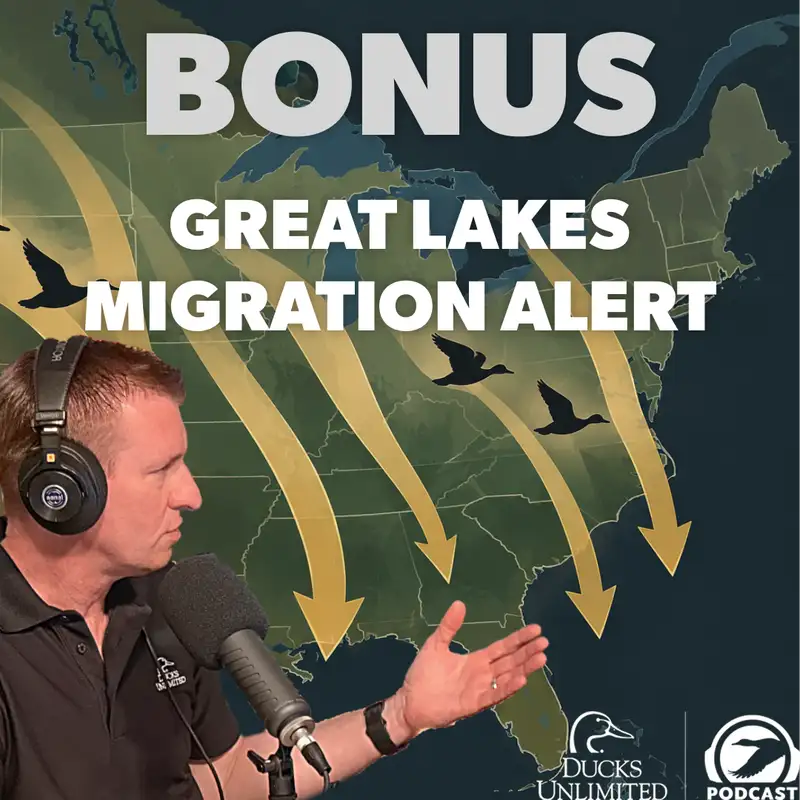
Great Lakes Migration Update: Divers Arriving, Geese Pushing & What Comes Next
You're tuned in to the Ducks Unlimited Podcast. Conserving wetlands, restoring habitat, and working to fill the skies with waterfowl today, tomorrow, and forever. From field tested hunting insights to the biggest conservation wins across North America, This is your front row seat to wetlands conservation in action. The DU Podcast is proudly sponsored by Bird Dog Whiskey and Cocktails. Whether you're wrapping up a hunt with your best friend or kicking back with your crew, Bird Dog brings award winning flavor to every moment.
VO:Enjoy responsibly.
Mike Brasher:Hey, everybody. Welcome back. I am your host on this episode, doctor Mike Brasher, and we are here with another migration and hunting update. And we are well... Welcoming in one of our favorite guests, a Migration Alert editor, Jay Anglin from up in the Great Lakes region.
Mike Brasher:Jay, it's always great to connect with you. Welcome back.
Jay Anglin:Hey. It's great to be here. Thanks for having me.
Mike Brasher:We're recording this on October 19. Hunting season is in full swing across many parts of the country. You guys have been going at it for a little while now, but give us a rundown on kinda how the first part of the season has gone for you. Remind people where you are, the places where you hunt, the people that you talk to, all that kind of stuff, just for folks that may be hearing from the incomparable Jay Anglin for the very first time.
Jay Anglin:So I'm I'm in Northwest Indiana, you know, about fifteen minutes from the Southeast Coast Of Lake Michigan, ten minutes from Michigan state line. So it's really actually... For someone that's keeping tabs on the Great Lakes, I'm kinda dead center almost. But, you know, overall, I cover, you know, Minnesota, Wisconsin, Illinois, Indiana, Michigan, Ohio. And, you know, the Great Lakes, I I think a lot of people don't realize how many birds migrate to both the Atlantic and the...
Jay Anglin:Of course, the Mississippi is what we're known for, but the land... A lot of birds cut across into the Atlantic as well. So migration here, in particular, in, like, Northern Wisconsin, Minnesota, and and especially, like, the northern, you know, third of, say, Michigan into the UP, a lot of those birds, you know, guys will hear, oh, there's a migration. You know, birds are going through, I read, and then they don't see them down south. Well, that's a lot of times because they're cutting across Ontario or going over to, you know, Lake Ontario or Eastern Lake Erie.
Jay Anglin:But nonetheless, so it's kind of important, I think, from my perspective to filter through all that. But... Yeah. You know, overall, I would say just real quick. I mean, it's been, I I would say, really good overall.
Jay Anglin:Weather, of course, always comes into play this time of the year unless you're hunting just strictly wood ducks or something that's a quick deal in morning. If it's, you know, 70 degrees and sunny and windless, then, you know, you might struggle a bit. The goose migration has been phenomenal. That's noteworthy. Early season, just at least in Michigan and Indiana, absolutely about as good as it gets.
Jay Anglin:We've been seeing snow geese here and a handful of specs for, like, two weeks in Northern Indiana. And I say a handful. I mean, literally, like, you know, you hear one or two or half dozen here and there, but that's always a good measure of how things are pushing through. Our diver flight is really kicking in. I talked to quite a few people that scraped...
Jay Anglin:You know, they were out hunting, say, you know, last weekend, and, you know, got a couple redheads or ringneck and didn't expect it. And I fully expected that with that incredible weather we had come through. Timing for us peaks here generally around Halloween into the first week of November, and that is about the same for the Mississippi. So you've got Wisconsin, Illinois, and I'll mention, you know, Minnesota, of course, and then also Iowa, even though it's not really in my territory, quote unquote. You know, it's it's applicable because that's certainly where a lot of birds come through that Mississippi River Valley, and then, of course, the Illinois River Valley.
Jay Anglin:So things are looking pretty good. A lot of the early season migrants are still straggling through here and there up north. So, like, Northern Wisconsin, Minnesota, they kinda weaned off those a bit. Wood Ducks definitely pushed out of a lot of areas, you know, north of here. And even here, I noticed I was on the river a lot guiding anglers.
Jay Anglin:And normally, I see, you know, smattering of wood ducks on each log jam, and I think last week, and I saw three, which kinda surprised me because normally we load up pretty good right now. So I think a lot of them pushed on some of those favorable winds and and and bolted. They're they're they're they'll be around, but nothing like that peak, which was probably a week or two ago.
Mike Brasher:Jay Jay, you mentioned recent weather. I have been... Man, I've been going left and right and back and forth for about the past three weeks, and it's been difficult for me to keep up with some of the weather systems and exactly how they've affected different parts of the country, especially up in the Great Lakes. So describe... Help me help me anyway and and our listeners too.
Mike Brasher:What what did that... When was the weather system or multiple weather systems that you're talking about? How cold did it get? How strong were the winds? What was that that weather system like that that sounds like maybe moved some birds?
Jay Anglin:Well, you know, we had gale warnings on the lakes beginning early last week, about a week ago, and they they held up because I ran up to Lake Michigan. I got off the river, came home, and Angie and I ran up to Buffalo, Michigan. And there was... By that time, they were probably 15 footers coming over the piers and stuff. But, you know, I I I never did read the final analysis on how big they got, but Lake Michigan was forecasted for 25 to 30 foot waves Wow.
Jay Anglin:Put it in perspective. Yeah. Those are massive, massive Great Lakes waves.
Mike Brasher:Yeah. You don't wanna be out on the water when that kind of stuff is coming through, do you?
Jay Anglin:You know, that's guaranteed. There's gonna be a little a little blip about you in the newspaper within a few days. But bottom line is those conditions are really conducive to, you know, hunting inland, especially in some of the larger lakes that, you know, associated with the Great Lakes. Because the Great Lakes are so vast, you'll have a lot of birds out there, and a lot of people really don't know they're there. You know, a bluebill or a redhead or, you know, etcetera.
Jay Anglin:Of course, we get a lot of sea ducks now, scoters, and long tails. They can ride that out pretty good. And and at some point, though, it just gets to be, you know, ridiculous. So they'll come inland to the nearest lake they can find, and I think that's one of the reasons why we do occasionally shoot oddball white wing scooters and stuff on these inland lakes. But was incredible.
Jay Anglin:The wind was, you know, 40 gusts to 50. You know, when I was on the water, excuse me, Friday, I wanted to go hunting so bad, but Michigan South Zone didn't open till Saturday morning. So it was a classic situation for migration. You had you know, the birds started pushing Thursday in earnest. I heard a lot of geese flying over, which, you know, doesn't really mean ducks came, but I suspected they were.
Jay Anglin:And then by Friday, it was full on push, but it was probably a a little too much. So I I was feeling, and this is good for the guys south of here, a lot of those early birds that rolled out, you know, they just shoved hard and kept going. And I can't officially say that. That's relatively anecdotal, but that's definitely one of the situations where you lose a lot of those early birds in these kinda mid latitude areas of the Great Lakes. But by Sunday morning, everything laid down.
Jay Anglin:Winds were five out of the east. It was, you know, mid thirties and the... You know, sunrise and... Or... Yeah.
Jay Anglin:Saturday morning. And so, you know, some people, when they're in the right spots, got into birds that were pushing, you know, still on the backside and and just dropping out. And a lot of people, though, said that they were surprised at how slow it was. So I suspect, like I said, a lot of the early birds, which would include pintails, which in green winged teal, still plenty of blue winged teal pushing through, and with ducks, was kind of slim pickings, and the guys that got out and actually hunted, like, more, say, late October, early November pattern for Mallards, and some divers did pretty darn good. I mean, I saw some amazing hunts.
Jay Anglin:I spoke to Joe Robinson over along the Detroit River right there. Well, it's, you know, it's actually Lake Erie, but that that that whole zone over there in Michigan, Southeast Michigan, lot of birds showed up. They... Said they did lose their wood ducks. I spoke with Brenda Kelly over in the Mississippi.
Jay Anglin:She said they had an outstanding second opener opener in Wisconsin due to conditions and number of birds, and that that as well went for Minnesota and Iowa. Joe Heron up on Lake Of The Woods, he said it was absolutely phenomenal. His dad reported incredible hunting with birds pushing out of Manitoba, and it said it was best it'd been in years. So we're getting really good reports overall. And I did see where whitefish point on Lake Superior, they do a they do a great job of monitoring bird migration.
Jay Anglin:They were getting really cool reports on long tails and, you know, some divers pushing through. And so, apparently, Saginaw Bay is really loaded up right now, and that's really important for, you know, Eastern Michigan in general. But Saginaw Bay is a is a really good barometer as to what's going on with the migration. So you have a a bunch of mallards, some blacks, pintails, and a whole bunch of divers out on Saginaw. Saint Clair's had some great...
Jay Anglin:Had a great opener in the flooded corn at Harrison's, and the lake itself is just, you know, starting to churn up a little bit. You know, as far as birds go, there's more and more every day. But I think their big push will probably be within the next two weeks for that first big push.
Mike Brasher:Yeah. Well, that's good to hear about Harrison's Island because I think as I... You and I were exchanging emails not too long ago, that's where I'll be in about two weeks. So I'm hoping that you are that you are right about your prognostication there. I do wanna back up a little bit and ask you kind of about the the early part of the season up there.
Mike Brasher:Those states in the Great Lakes region do produce a lot of local birds. Those, I suspect, are are gonna are gonna fuel much of the early hunting. Do you have any indication based on what you've heard or what you saw in terms of the number of young birds that were harvested to how this year's production may have gone in the Great Lakes States?
Jay Anglin:That's a really good question. And the honest answer is is I I I don't have, like, really a great feel for that yet. But I will say this. I... I'm hearing reports of birds just absolutely dive bombing into spreads, and I'm seeing a lot of pictures that look, you know, in a photo on my phone, look like juvenile ducks.
Jay Anglin:So... Or, you know, young of the year. So we have a fair number of birds this year. You know, it was... There was a lot of drought, and that should be mentioned.
Jay Anglin:There was drought, you know, for years here for the last few years, and, of course, it impacted waterfowl production tremendously all across the the Northern tier, you know, well into the Plain States and and and the prairie powwow region. But we picked up water in some areas, and it was kinda weird because, like, over in Indiana here, you know, west of me about ninety minutes or so, you know, Mike Shoemaker at Willow Slough, just dry as a bone, and he's trying to put water on new projects and moist soil units and things that he's done a really outstanding job on zeroing in on some really good public, you know, assets for hunters. But it was dry. And and then you go 20, 30 miles away, and it's like the fields are flooded. So some of those big systems that came through kinda gave a lot of relief to some areas and very little others.
Jay Anglin:But Wisconsin in particular was very dry. I did see where they got a good slug of rain over the weekend in some areas. Minnesota picked up some rain. Michigan picked up rain. In Indiana here, some of my areas I haven't hunted in two or three years due to due to dry conditions have water.
Jay Anglin:So I'm seeing a lot of birds on those over the last month, which suggests, you know, there are fair number of of of local birds still here, of course. But on the river, which is always my barometer this time of year as far as bird numbers, I'm seeing a ton of mallards that in my view are not birds that have come down. They're... So I, you know, that's again relatively anecdotal. But it it is so far, so good.
Jay Anglin:I think it's looking pretty darn good.
Mike Brasher:Yeah. So Jay, I wanna take a break right here, and then we're gonna come back in on the other side of this. I wanna wanna ask you a little bit more about the Mallards that you saw on the river there, but then I also wanna look out into the future. I pulled up a weather forecast earlier, so I wanna talk about that a little bit. And then longer term view for the rest of the season in the Great Lakes Region.
Mike Brasher:So stay with us, folks. We'll be right back.
VO:Stay tuned to the Ducks Unlimited Podcast sponsored by Bird Dog Whiskey after these messages.
Mike Brasher:Welcome back, everyone. We are here with Jay Anglin, our migration alert editor for the Great Region. Jay, you mentioned a moment ago that you saw a lot of birds, a lot of mallards on the river, and you said... I think you described it as those... I forget what you said, if those are birds that haven't moved down yet.
Mike Brasher:Now does that mean that those are local birds still? And when I say local, I mean birds that would have been produced, would have been breeders within the Great Lakes region, or are those birds that have migrated in just haven't migrated all the way through?
Jay Anglin:It could be a little bit of both, but predominantly, I would say those are locally produced birds. And we had, gosh, year class wise with mallards in particular. And granted, a lot of these are urban ducks and and, you know, suburban ducks. And that's also... You know, when I'm floating by on a 16 foot drift drift boat, two guys are fly fishing.
Jay Anglin:That's enough activity that a wild bird from Manitoba or Saskatchewan's gonna roll. You know? They're gonna be like, no. But but these birds are swimming into the into the, you know, sweepers on the river. They might hop a 100 yards or whatever.
Jay Anglin:And that's over the years, I've gotten to the point where I'm like, okay. Yeah. These are local birds that are just... You know, they're used to seeing this. But, there there was probably two, maybe three different, hatches and, you know, in the areas that I kinda watch and keep it, you know, pay attention.
Jay Anglin:So even failure... Nest failure, predation, what have you. I mean, it's just... Gosh. It was probably a month ago.
Jay Anglin:I saw small ducklings in some of the more rural stretches of river, and I'm talking mallards. It seemed like woodies were down a little from what I usually see as far as local production, which doesn't make a lot of sense because we had more water, and it could be that they were just spread back into their better habitat in the middle of a wood line, a little half acre, you know, you know, wetland in the middle of the woods, and I just wasn't seeing them because it wasn't there. But... Yeah. I mean, it it it looks pretty good, and I I mean, the the the reports I'm getting, you know, this weekend, Indiana had their veteran slash youth hunt, and I just spoke to Reed Stiller at Kingsbury right down the street here, and he said they did very, very well on birds.
Jay Anglin:I didn't get a breakdown of what they shot, but I'm assuming it was a lot of the early migrants plus, you know, mallards. And it's quite possible with that front that came through that they were getting into some some birds that were pushing through.
Mike Brasher:That that's all great news to hear. I have heard from other people as well a report of very late broods. I've heard it from folks in the Great Lakes region, Michigan specifically. I've also heard it from up in the Canadian Prairies, and I'm, you know, the the, I guess, scientist and biologist in me says that's an artifact of of weather... Wetland conditions that were good when birds arrived and wetland conditions that stayed good throughout the season as a result of some favorable precipitation that did arrive periodically.
Mike Brasher:I know things started to dry out a little bit in parts of the Great Lakes here towards the end of the summer. Do I remember? At least I think I remember that, But it sounds like it was at least good enough in some locations to produce birds late into the summer.
Jay Anglin:Oh, yeah. I believe so. And, you know, a lot of times, you know, the focus on wetlands obviously is critical for us to, you know, going forward, has been for, you know, a hundred years as far as waterfowl management. But one thing is for certain that the streams don't dry up. And while they may be less than half of their normal flow, that's still a heck of a lot of water in most cases.
Jay Anglin:So, you know, if you have a wetland that sort of erodes and dries up and gets the point where it's not really usable, you know, generally speaking, in the Great Lakes, there's a river within 10 miles and usually within five and oftentimes within, like, a 100 yards. So... Because a lot of our wetlands are associated with bottom lands, you know, Not all of them, but certainly a good portion of them. So I would say that, you know, it's ideal, really. In a dry year, we still produce ducks.
Jay Anglin:But when we do have the habitat that those ducks desire, the nesting habitat in particular alongside those wetlands, we have good production. And I think this year was gonna be one of the better years, certainly, as you mentioned, and and I had, you know, witnessed myself. There was multiple nesting cycles, if you will. And they seem to be pretty synced. You know, you'd see, like, ducklings of three different drastically different sizes in broods.
Jay Anglin:And the broods, I should mention also, and this goes for also some of the wetlands in the area that picked up water, you know, very timely this spring. The broods were big. I was seeing a lot of broods that were big, like, you know, eight to take 12 ducklings, you know, in in mallards and in some cases, woodies. But, I mean, I saw a few teal nest around here. We had blue wings nest, and I've seen green wings nest in Northern Indiana.
Jay Anglin:It's not very common, but certainly blue wings were present. Of course, they skedaddle before we even have our early teal season. You know? They're probably in Costa Rica by now, but, hey, they're they're Indiana birds by my... In my book.
Jay Anglin:So.
Mike Brasher:Yeah. For sure. It's... Everything that you're telling me aligns with some of the other messages that I've heard from other people. One of those is our friend, Soulier, out on Harson's Island.
Mike Brasher:They were out there this past weekend for the opener, and he was telling me by way of text message that on opening morning, there were more boats, more hunters in that bay that he hunts than he can... Could remember in many years. He said they... There were hunters already at two, if not three of the spots that he normally goes to, and so he had to resort to, like, option c or d. I...
Mike Brasher:He didn't say how much shooting he heard that morning. I do know that he had a good hunt yesterday on a fairly... I mean, had a good hunt. I think he shot four birds, but, you know, things have been favorable, I guess, it sounds like where he is as well, so I'm encouraged to hear that. What are you...
Mike Brasher:I looked... Pulled up the weather weather channel or or weather forecasting station a few minutes ago and looked, I think, in Lansing, Michigan for the next ten days. It doesn't look like there's much of any additional system that's on the way. It's like a carbon copy from day to day for about the next seven to ten days. Is that what you're seeing and anticipating?
Mike Brasher:And if so, what do you think that means for hunters over the near term?
Jay Anglin:I did... I mean, yeah, I noticed it because I monitor it about every other hour for fishing purposes, and barfowl, and deer hunting, and all the other hunting. But it's beautiful. I mean, if you wanna go take a walk, it doesn't get much better, you know. You know, cool nights and relatively warm days as far as you know me, it's not gonna be 80.
Jay Anglin:It's not gonna be 50. It's gonna be, you know, in the sixties, and it'll be mundane. You know, a lot of guys probably say, you know what? I'll go deer hunting. I'm gonna go with a soccer practice and watch, you know, junior plays, whatever.
Jay Anglin:And and because of that... And, of course, this is just savvy talk, not necessarily anything scientific. But in my view, when birds do decide to push on on... In, you know, sort of mundane conditions like that as far as waterfowl hunting goes, they kinda load up in some areas, you didn't expect it to happen. So then you go out.
Jay Anglin:Oh, well, I'll force myself to go out Friday. I got the day off. And all of sudden, you just have one of the great hunts because no one's been hunting because it just seemed like terrible conditions, but for hunting. But I would say it's probably gonna be a little bit idle right now. I think if you get some favorable winds, you'll get the classic, you know, calendar migration of ring necks and some redheads, and they'll creep in pretty quick.
Jay Anglin:You know, with crops coming off up here aggressively right now, corn just... They're murdering corn right now. Beans are starting to come out. That's the same, you know, if you go east, you know, like East of Saint Clair, you get up north north of the lake and east, you know, in Ontario, You know, they're they're dealing with the same thing. They're probably actually moving at a pretty good pace right now.
Jay Anglin:I'd have to guess because it's not that much further north than this. That's important to me in some of the Great Lakes, especially the Eastern Great Lakes because a ton of those birds come out of Ontario and and Western Quebec. And I have the band returns on those to... You know, it's prompted by that. You know?
Jay Anglin:I'm like, wow. This is interesting, and then I'd look a little deeper and kinda figure out. If you if you talk to, like, John Darling at at Harrison's, the number of band returns they get out of Ontario is staggering. And so with those birds having plenty of food to dry feed on and some water in the... In in those wetlands, you know, those birds might be, you know, slower to get down into the the big city lights of Detroit and places like that, Toledo, because they don't have to.
Jay Anglin:So until we get our next big, you know, really cold weather and some snow, I think it's definitely gonna be, you know, a little slower than than we'd like to see. Well, it
Mike Brasher:may be slow for waterfowl hunting because of some of the things that we've talked about weather wise, but this has to be... There are... As you said, there are a lot of other options for for hunters and anglers in the Great Lakes States. This has to be your favorite time of the year, because if it's not right for ducks or geese or even for deer, there's a pretty good chance that it's also good for fishing of some sorts, whether you're talking walleye or anything else that you're chasing. How has that been, And are you gonna be shifting any of your time here over the next few days to to to be on the water chasing the fish rather than the ducks because of the nice weather you've got?
Jay Anglin:Well, that's a good question. And honest... You know, I thought about that actually because I kinda thought you might say something about that.
Mike Brasher:I know you pretty well.
Jay Anglin:Yeah. So I think, you know, right now, it's like a little bit of everything, but not a lot of anything. And the exception to that, I would say right now, is don't mind the three Labradors barking at the UPS guy. It's all good. I would say I would say walleyes, ironically, that you mentioned that the fall bite is really good right now.
Jay Anglin:I mean, absolutely awesome. It's so easy. You just go out, find a spot where there's walleye, and you throw a rapple at them and, you know, do the jerk twitch thing, and you catch a nice eater walleye. I don't do that a lot because I'm encumbered by steelhead and salmon and trout and smallmouth bass and musky and pike, but that's been pretty good. The salmon run kinda fizzled here and up north.
Jay Anglin:It's probably coming into the backside, which means winter steelhead, which are coming in, and that is the best part of the year. And, yes, this is my favorite time of year. It's the busiest time of year. If I could take October, say, tenth through about November 20 and stretch it out over, you know, half the year, I'd be a lot happier. I mean, everything's going on.
Jay Anglin:Bird hunting's phenomenal. Of course, the duck hunting. If you just wanna go shoot a few ducks, go go with duck hunting on a creek or a ditch or a little marsh, and you'll have plenty of time to go home and get a shower before you go to work. I mean, you know, they're they're here. There's enough.
Jay Anglin:Huge mass crop this year. That'll hold woodies for sure. I do think we're coming on the backside of that. But anyway, yeah. No.
Jay Anglin:It's really, really good. And the fishing's been pretty darn good, but not, like, outstanding, put it that way.
Mike Brasher:As a as a person that grew up in the South, didn't really think a whole lot about the Great Lakes State, so that region, I have been blessed by having some friends up in that area and being able to travel there over the past twenty years, and that I now realize, I mean, it's almost... And and you will probably laugh at this, but as someone who is from outside that region, the Great Lakes region is a bit of a hidden gem to a lot of people. A lot of people just don't understand how truly special it is and how many opportunities for outdoor activities there are throughout the year. Obviously, there are a lot of lakes there. That seems like a ridiculous statement to say, but people that don't live there, people that don't travel there, that don't visit the lakes, the streams, the wetlands, aren't...
Mike Brasher:That haven't experienced the different types of fisheries that you just kinda ticked off the list, they don't really understand the the wealth of opportunities that that region presents itself. And and like I said, I've been very fortunate to be exposed to a fraction of that, but I am sure it's one of the things that makes you thankful to be a Midwestern to live up there right in the heart of it all. And so what would you... How do you... I'm sure you love telling people about the Great Lakes.
Mike Brasher:So what's your description, your message to people in in in describing what that... What it's like to
Jay Anglin:live there? That's remarkable because it's, of course, I mean, these lakes are massive. I mean, I don't think the average person truly understands how magnificent these lakes are in terms of their size, and they're connected, and everything's connected. But, you know, there is an amazing diversity of outdoor pursuits. And I tell people all the time, yeah, you don't wanna go hunting and fishing.
Jay Anglin:Just take a drive and do a tour. Go up through Michigan. Right now, the leaves are peaking up north. Go across the UP, stop at Marquette, have dinner, incredible town, that's... You know, when I went to Northern Michigan University up there, fell in love with it, and and then drive back down through Wisconsin, and that gives you a real good feel for, you know...
Jay Anglin:And then you have cities like Chicago and Detroit and Cleveland, etcetera. And it... It's just vibrant. But as an outdoorsman, one of the biggest issues this time of year is picking what to do or how many of those things you're gonna do in a single day. I mean, you know you know, you start out deer hunting in the morning, and then you go, you know, dozen hunting, and then you decide, you know, I'm gonna I'm gonna go ahead and try to do an evening goose hunt somewhere.
Jay Anglin:You know? It just it just goes on and on. So, yeah, we're we're truly blessed between the fishery and the hunting opportunities that are super diverse. I mean, there's... You know, look at the UP.
Jay Anglin:You have you have mountain lions. You have wolves. You have moose, deer. I mean, I saw a wolverine in 1995 in The UP. I mean, it's it's wild.
Jay Anglin:It's wild. And that's what makes it different. And down here, you know, we're kind of in the corn country, but I have, you know, fit... Like I said, fifteen minutes away is Lake Michigan, which has the... Arguably the best beaches in the Great Lakes.
Jay Anglin:It's pretty cool.
Mike Brasher:Jay, we're gonna wrap it up here. That is a phenomenal sort of overview of what it's like to live there in the Great Lakes region and the outdoor opportunities that it presents. I will be up there soon to enjoy a small sliver of that. We try... We were gonna try to connect.
Mike Brasher:Our schedules didn't align, but we'll make that happen eventually. You and I have kinda talked about that occasionally. It hasn't happened yet, but one of these years, we'll make it happen. Thank you for joining us here, Jay. Thanks for all the insight that you bring.
Mike Brasher:We'll check-in with you here in another month or two to figure out how the rest of the waterfowl hunting season is unfolding. If you're a waterfowl hunter, Jay's giving you a great update on how things are occurring. Sounds like it's worth finding the days to get out there, enjoy the opportunities that you have as a waterfowl hunter, angler, deer hunter, whatever else may be the case. Thank you so much, Jay.
Jay Anglin:Hey. I love being on, and, folks, go out there and have some fun out there. If you don't get anything, at least you're outside enjoying the outdoors.
Mike Brasher:Amen. A very special thanks to our guest on today's episode, Jay Anglin, the incomparable Jay Anglin, a Migration Alert Editor for Ducks Unlimited up in the Great Lakes region. Appreciate his time and expertise. We always also thank our producer, Chris Isaac, for the great work that he does getting these episodes out to you. We thank you for listening.
Mike Brasher:We thank you for your support of wetlands and waterfowl conservation.
VO:That's a wrap for today's episode of the Ducks Unlimited Podcast brought to you by Bird Dog Whiskey and Cocktails. From post hunt unwinds to celebrations back at camp, Bird Dog delivers award winning flavor to every moment. Enjoy responsibly. Don't forget to rate, review, and subscribe, and check out ducks.org/du podcast for more stories, science, and all things waterfowl. Guest opinions are their own and don't necessarily reflect those of Ducks Unlimited.
VO:Until next time, stay fired up, stay focused, and stay tuned to the Ducks.
Creators and Guests